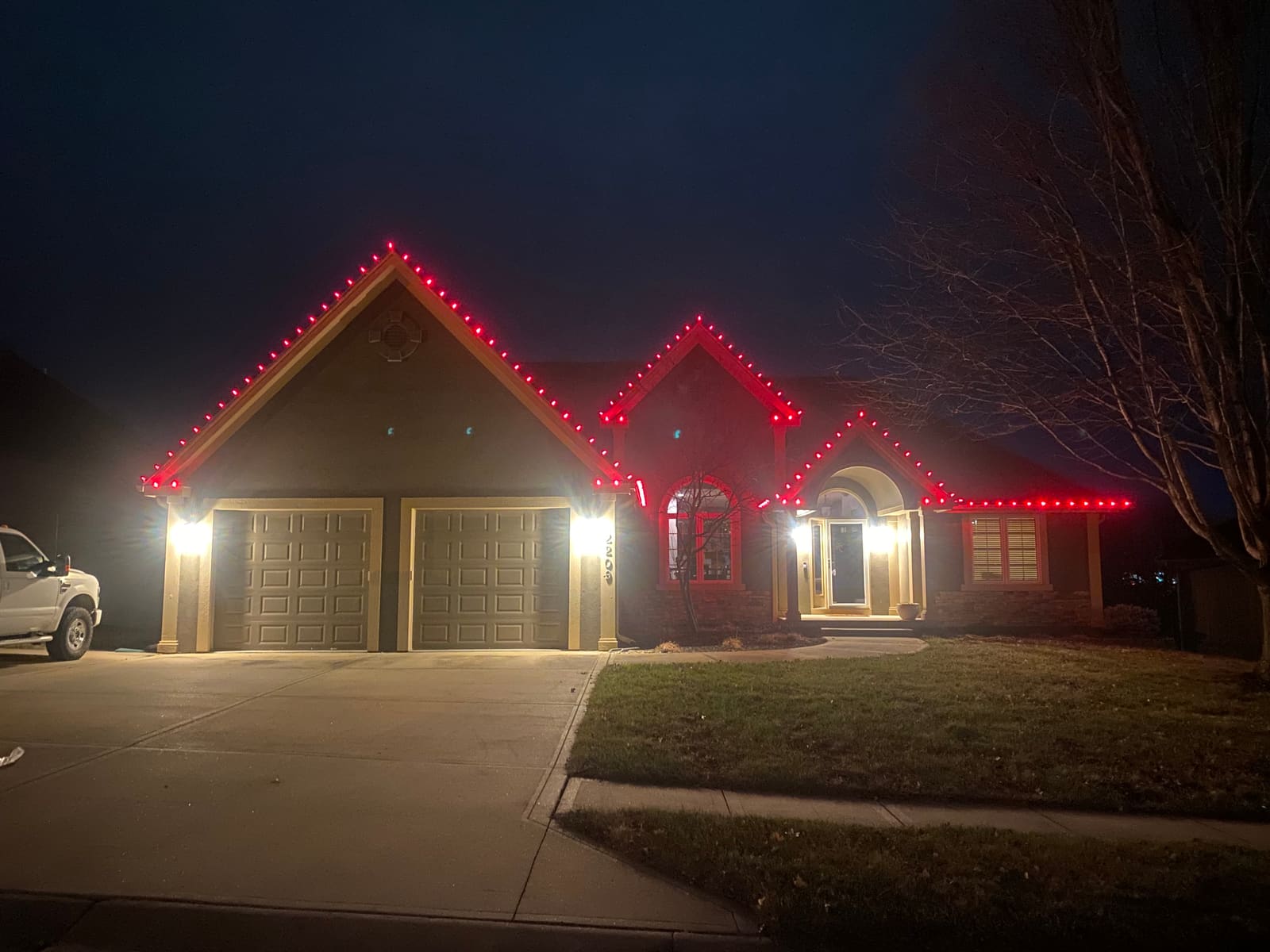
Both routes get lights on your house. The real differences show up in the hours you spend, the ladder time in cold weather, and how the display looks once it is up. Here is what each option actually involves around Kansas City, so you can decide with your eyes open.
What DIY Christmas Lights Really Involve
DIY means every step is on you, from buying the right lights and clips to climbing the ladder yourself in December weather. That starts before you ever touch the roofline: measuring your eaves and peaks, figuring out how many strands and clips you need, and choosing between C9 bulbs, mini lights, or something newer.
Once you have the materials, the work moves outside. That means a ladder on frozen or wet ground, walking a roofline in the cold, and getting the spacing between bulbs even so the finished look reads clean instead of uneven. Gutters and shingles get slick fast once temperatures drop, which makes footing and balance harder than it looks in October.
The job is not done once the lights are up. A strand can go dark partway through the season, and finding the bad bulb or connection means getting back on the ladder, sometimes more than once. Then in January, everything comes down, gets untangled, and needs a place to live for the next eleven months, usually in a garage or attic bin that is easy to forget about by next fall.
What Professional Installation Includes
A professional installation covers the full season, not just the day the lights go up. Working with a company like A Plus Christmas Lights KC means the process starts with a design for your specific home, then moves to installation using commercial-grade LED lights supplied by the company, custom-cut to your roofline.
Installers use professional clips and manage the wiring so it stays hidden and weather-resistant, with timers and controls set up as part of the job. Through the season, if something goes out, it gets fixed. After the holidays, usually in January, the crew takes everything down and stores it, labeled, until next season. You can read the full sequence on our how it works page.
The Look: Custom Fit vs. Off-the-Shelf
A custom-cut installation tends to look more finished because the lights are sized to your exact roofline instead of stretched or bunched to fit whatever length a box comes in. Spacing stays consistent across peaks, gables, and long runs, and the wiring is tucked out of sight instead of draped along the gutter.
DIY strands are built to a standard length, so most homes end up with at least one run that is a little short or a little long. That is not a failure on your part. It is just how off-the-shelf lighting works on a roofline it was not measured for. Browse real examples of custom-cut installs in our gallery to see the difference in spacing and finish.
Safety: Ladders and Rooflines in Winter
Ladders and rooflines carry real risk once winter weather shows up, especially with wet leaves, frost, or ice on the surfaces you are standing on. Cold hands, shorter daylight, and slick footing all stack the odds against you compared to doing the same climb in July. That risk does not disappear because a strand of lights only takes a few minutes to hang. It is the getting up and down that adds up, especially on a two-story roofline or a steep pitch.
Professional vs. DIY at a Glance
| DIY | Professional Installation | |
|---|---|---|
| Design & planning | You measure, plan and buy the materials | Custom design for your home before install day |
| Materials | Whatever length and style you find in stores | Commercial-grade LEDs, custom-cut to your roofline |
| Ladder & roof time | Yours, in whatever weather that week brings | Handled by the installation crew |
| Mid-season outages | You find and fix the problem | Reported and repaired as part of the service |
| Takedown & storage | You take it down, untangle and store it | Removed, labeled and stored until next season |
Who Should DIY, and Who Should Hire a Pro
DIY genuinely suits some homeowners: a single-story home with a simple roofline, comfort on a ladder, and time to spare on a weekend in November. If that describes your house and your schedule, doing it yourself is a reasonable choice, and there is no wrong answer here.
Hiring a professional makes more sense if your home has multiple stories, steep pitches, or a roofline with a lot of peaks and gables, or if you would rather not spend a cold weekend on a ladder and another one in January taking it all down. It also helps if you want a more polished, evenly spaced look without trial and error. See our residential Christmas light installation page for what that service covers, or see what affects pricing before you decide.
Whichever way you go, the earlier you plan, the better. If you would rather hand the ladder work to someone else this year, A Plus Christmas Lights KC serves Independence and the Kansas City metro.